

Have you ever found yourself lying awake at 2 AM, consumed with thoughts like “Do I really love my partner?” or “What if we’re not meant to be together?” — even though your relationship feels good during the day? You’re not alone, and you’re not losing your mind.
Relationship OCD (ROCD) affects millions of people, creating intrusive doubts and compulsive behaviors that can strain even the healthiest partnerships. These aren’t just normal relationship concerns — they’re persistent, distressing thoughts that feel impossible to shake.
In this post, you’ll learn to recognize the 7 essential signs of relationship OCD, discover evidence-based strategies to find peace, and understand how to support yourself or your partner through this challenging but very treatable condition. Most importantly, you’ll discover that having ROCD doesn’t mean your relationship is doomed — it means your brain needs some extra support.
What Is Relationship OCD? Understanding the Basics
Relationship OCD is a subtype of Obsessive-Compulsive Disorder that centers around romantic relationships. Unlike typical relationship concerns, ROCD involves:
Obsessions: Intrusive, unwanted thoughts about your relationship or partner Compulsions: Repetitive behaviors or mental acts aimed at reducing anxiety
The cruel irony? The more you try to “figure out” these doubts, the stronger they become. Dr. Sarah Mitchell, a licensed clinical psychologist specializing in OCD treatment, explains: “ROCD hijacks the brain’s natural bonding process, turning love into a source of anxiety rather than comfort.”
Two Main Types of Relationship OCD
Partner-Focused ROCD: Obsessive doubts about your partner’s suitability
- “Are they attractive enough?”
- “Do they have the right personality?”
- “What if there’s someone better out there?”
Relationship-Focused ROCD: Obsessive doubts about your feelings
- “Do I really love them?”
- “Am I feeling the ‘right’ kind of love?”
- “What if I’m just settling?”
7 Essential Signs of Relationship OCD

1. Constant Analyzing of Your Feelings 🧠
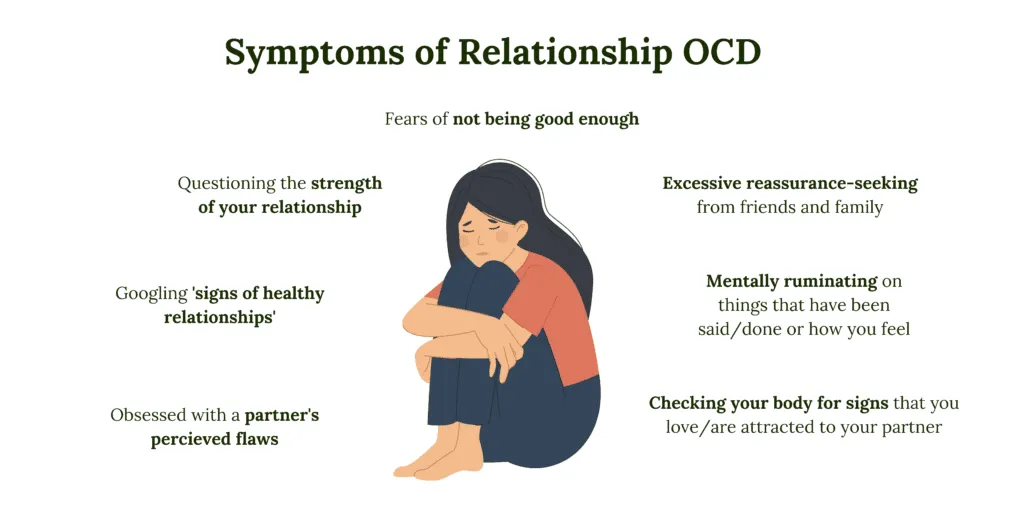
You find yourself repeatedly checking in on your emotions: “Do I feel butterflies when I see them? Did I feel love just now?” This emotional monitoring becomes exhausting and counterproductive.
2. Comparing Your Partner to Others
Whether it’s people you know, celebrities, or even fictional characters, you can’t stop measuring your partner against others and finding them lacking in some way.
3. Seeking Excessive Reassurance
You frequently ask friends, family, or online communities questions like “How do you know if you’re with the right person?” The relief from their answers never lasts long.
4. Mental List-Making
You compulsively create pros and cons lists about your relationship, analyzing every interaction for evidence of compatibility or incompatibility.
5. Physical Response to Relationship Thoughts
Your body reacts strongly to ROCD thoughts — racing heart, sweating, nausea, or feeling disconnected from your partner during intimate moments.
6. Avoidance Behaviors
You might avoid couple activities, future planning, or even physical intimacy because these trigger uncomfortable doubts and anxiety.
7. All-or-Nothing Thinking
Your relationship feels either “perfect” or “doomed” with no middle ground. Small issues feel like relationship-ending catastrophes.
✨ Pro tip: If you recognize 3 or more of these signs happening regularly, it may be worth exploring ROCD treatment options.
The Science Behind Relationship OCD
Research from the International OCD Foundation shows that ROCD affects approximately 1-3% of the population, with many cases going undiagnosed. The condition often emerges during major relationship milestones — moving in together, engagement, or marriage.
Dr. Jennifer Walsh, relationship therapist and OCD specialist, notes: “ROCD isn’t about the relationship itself being problematic. It’s about the brain getting stuck in loops of doubt and uncertainty, which ironically can affect perfectly healthy relationships.”
What Triggers ROCD?
Common triggers include:
- Relationship milestones and commitments
- Stress from other life areas
- Exposure to “perfect” relationships on social media
- Past relationship trauma or attachment issues
- General anxiety or depression
7 Peaceful Solutions for Managing Relationship OCD

1. Practice Uncertainty Training
Instead of trying to find absolute certainty about your relationship, practice sitting with uncertainty. Remind yourself: “I don’t need to know with 100% certainty. Most people in healthy relationships have doubts sometimes.”
2. Limit Reassurance Seeking
Set boundaries around asking for reassurance. Instead of seeking constant validation, try journaling your concerns or talking to a therapist who understands ROCD.
3. Use the “STOP” Technique
When intrusive thoughts arise:
- Stop what you’re doing
- Take a breath
- Observe the thought without judgment
- Proceed with a chosen activity
4. Focus on Actions, Not Feelings
Judge your relationship by your actions and your partner’s actions, not by fleeting emotions or thoughts. Do you treat each other with kindness? Do you enjoy spending time together? Do you support each other’s goals?
5. Practice Mindful Acceptance
Instead of fighting ROCD thoughts, acknowledge them: “I’m having the thought that I don’t love my partner enough. That’s just my ROCD brain acting up.” This creates distance between you and the thought.
6. Establish “ROCD-Free” Times
Designate certain hours each day as relationship-doubt-free zones. During these times, engage fully in activities together without analyzing your feelings.
7. Build a Support Network
Connect with others who understand ROCD through support groups or online communities. Knowing you’re not alone can be incredibly healing.
Real-Life Success Story
“I spent two years convinced I was going to break up with my partner because I didn’t feel ‘in love’ every single moment,” shares Maria, 28. “Through therapy and learning about ROCD, I realized my brain was just stuck in an anxiety loop. We’ve now been married for three years, and while I still have occasional doubts, I don’t let them control my decisions. The relationship I almost ended turned out to be exactly what I needed.”
When to Seek Professional Help
Consider reaching out to a mental health professional if:
- ROCD thoughts consume more than an hour daily
- You’re avoiding relationship commitments due to doubts
- The anxiety is affecting your work, sleep, or other relationships
- You’re considering ending a generally healthy relationship solely due to intrusive thoughts
- Your partner is becoming frustrated with constant reassurance-seeking
Treatment Options That Work
Cognitive Behavioral Therapy (CBT): Helps identify and challenge distorted thinking patterns
Exposure and Response Prevention (ERP): Gradually exposes you to uncertainty without performing compulsions
Acceptance and Commitment Therapy (ACT): Focuses on accepting difficult thoughts while acting according to your values
Medication: SSRIs can be helpful when combined with therapy
Supporting a Partner with ROCD
If your partner struggles with relationship OCD:
Do:
- Educate yourself about the condition
- Be patient with their need for reassurance (while setting healthy boundaries)
- Encourage professional treatment
- Focus on your partner’s actions rather than their anxious thoughts
Don’t:
- Take their doubts personally
- Provide excessive reassurance (this can worsen symptoms)
- Try to logic them out of their concerns
- Threaten to leave because of their OCD
Disclaimer: This post is for informational purposes only and is not a substitute for professional mental health treatment. If you’re experiencing significant distress, please consult with a licensed therapist or counselor.
Last updated: September 5, 2025
Conclusion: Finding Peace in Love Again 💕
Relationship OCD can feel overwhelming, but remember — having these doubts doesn’t mean your relationship is wrong or that you’re a bad partner. ROCD is a treatable condition that affects many loving, committed people.
The path to peace involves learning to tolerate uncertainty, focusing on actions rather than feelings, and often working with a therapist who understands OCD. Your relationship deserves the chance to flourish without the constant interference of anxious thoughts.
You’re already taking a positive step by educating yourself about ROCD. Trust that with the right tools and support, you can learn to quiet the noise of anxiety and reconnect with the love that brought you together in the first place.
Read Also: Essential Platonic Relationship Tips
FAQs About Relationship OCD
What causes relationship OCD to develop?
ROCD typically develops from a combination of genetic predisposition to anxiety disorders, environmental stressors, and sometimes past relationship trauma. It’s not caused by relationship problems themselves.
Can relationship OCD be cured completely?
While there’s no “cure” for OCD, ROCD is highly treatable. Many people learn to manage symptoms effectively and maintain healthy, fulfilling relationships.
How do I know if my doubts are normal or ROCD?
Normal relationship doubts come and go, while ROCD doubts are persistent, distressing, and interfere with daily life. If you’re spending hours analyzing your relationship daily, it may be ROCD.
Will medication help with relationship OCD?
SSRIs can be helpful for reducing the intensity of OCD symptoms, but therapy (particularly ERP) is considered the gold standard treatment. Many people benefit from a combination approach.
Can someone with ROCD have a successful long-term relationship?
Absolutely! Many people with ROCD maintain happy, healthy long-term relationships and marriages. The key is proper treatment and learning to act based on values rather than anxious thoughts.